
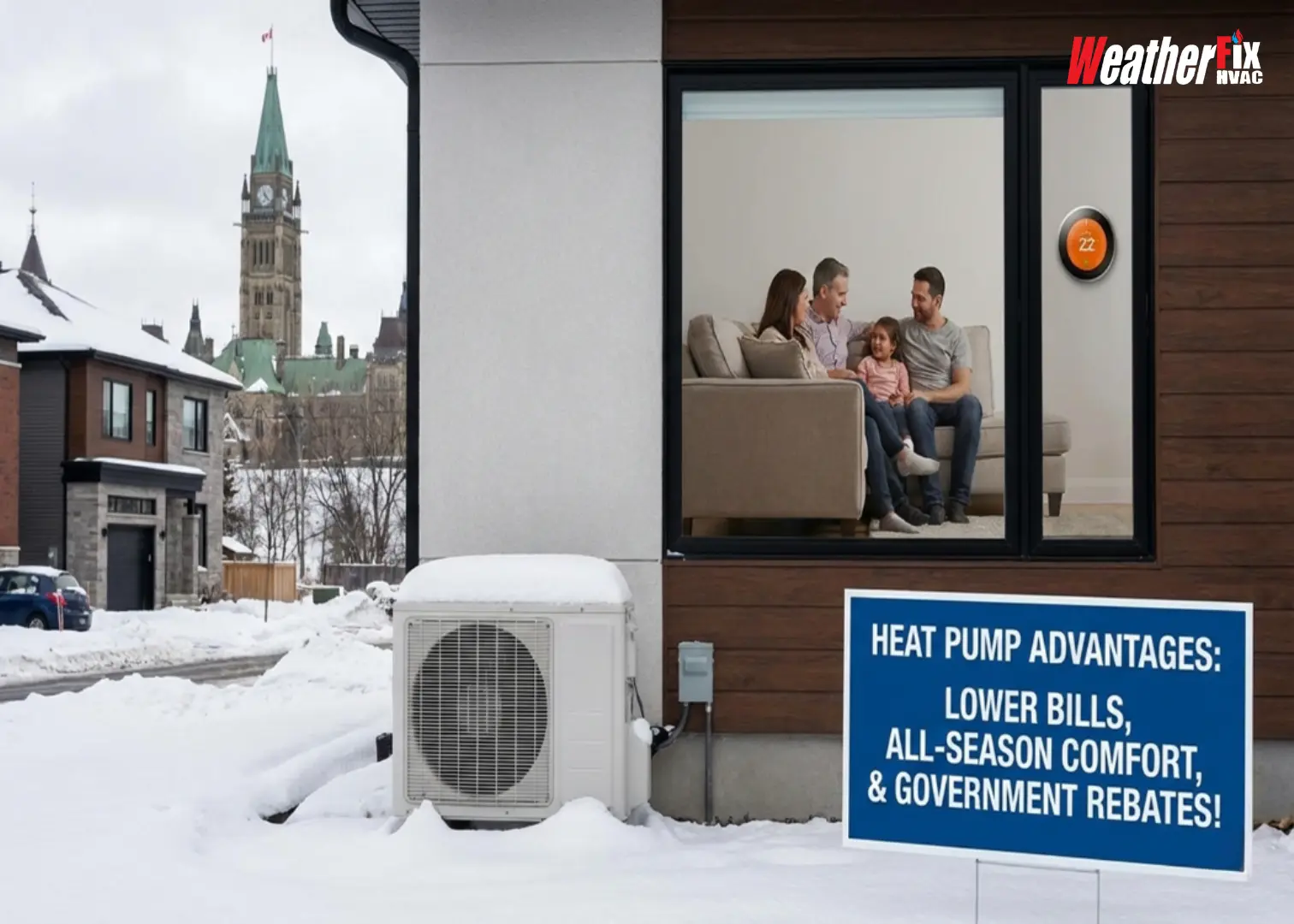
In the National Capital Region, homeowners are constantly looking for ways to battle our extreme climate without breaking the bank. We face sweltering, humid summers and bone-chilling winters where temperatures can drop below -30°C. For decades, the standard solution has been a natural gas furnace paired with a central air conditioner. However, as energy prices rise and carbon taxes increase, a new champion has emerged in the Ottawa HVAC market: the cold-climate heat pump.
If you are considering upgrading your aging system, you are likely asking what are the advantages of having a heat pump compared to the traditional furnace-and-AC setup. The answer goes far beyond just “energy savings.” It involves a fundamental shift in how we heat and cool our homes, offering superior comfort, safety, and versatility.
This guide will explore the top benefits of installing a heat pump in Ottawa, explain how they handle our deep freezes, and detail the financial incentives available in 2026 that make the switch more affordable than ever.
What Are the Advantages of Having a Heat Pump?
A heat pump is essentially a two-way air conditioner. In the summer, it removes heat from your home. In the winter, it reverses the process, extracting heat energy from the outdoor air and pumping it inside. This unique technology offers several distinct benefits over traditional fossil fuel systems.
1. Unbeatable Energy Efficiency
The most significant advantage is efficiency. A gas furnace creates heat by burning fuel, which is efficient but limited (even the best furnace is only 98% efficient). A heat pump, however, moves heat rather than creating it. For every 1 unit of electricity it consumes, it can move 3 to 4 units of heat into your home. This results in an efficiency rating (COP) of 300% to 400%. This massive efficiency gap means you get significantly more heat for every dollar you spend on energy.
2. One System for All Seasons
When you install a heat pump, you are solving two problems at once. You get a high-efficiency heating system for the winter and a top-tier air conditioner for the summer. This simplifies your home maintenance. Instead of worrying about two separate aging units, you focus on maintaining one comprehensive system. This dual functionality frees up space and streamlines your annual maintenance schedule.
3. Enhanced Safety (No Combustion)
Because a heat pump runs entirely on electricity, there is no combustion process inside the unit. This eliminates the risk of carbon monoxide leaks from cracked heat exchangers—a common and dangerous issue with aging gas furnaces. For families with young children or elderly relatives, this peace of mind is invaluable. Eliminating gas combustion removes the single biggest respiratory safety risk in your home’s mechanical room.
4. Precise Temperature Control and Comfort
Old furnaces often operate on a “blast and wait” cycle: they blast hot air until the house is overheating, then shut off until it’s freezing again. Modern heat pumps use “inverter” technology. The compressor speeds up or slows down gently to maintain a constant, steady temperature. This variable-speed operation eliminates cold spots and temperature swings, keeping your home perfectly comfortable all day.
5. Lower Carbon Footprint
In Ontario, our electricity grid is relatively clean. By switching from a fossil-fuel-burning furnace to an electric heat pump, you drastically reduce your home’s carbon emissions. For Ottawa homeowners looking to be part of the climate solution, this is the single most impactful change you can make. Switching to a heat pump is a direct, measurable action that lowers your personal environmental impact.
The “Cold Climate” Advantage: Do They Work in Ottawa?
A common myth is that heat pumps stop working when it gets cold. While this was true 20 years ago, today’s technology is vastly different.
Modern “Cold Climate” Air Source Heat Pumps (ccASHP) are designed specifically for Canadian winters. They can maintain 100% of their heating capacity at temperatures as low as -15°C or -20°C, and continue to provide efficient heat down to -30°C.
However, for absolute security during Ottawa’s coldest nights, many homeowners opt for a Hybrid System. This setup uses the heat pump for 80-90% of the winter. On the few nights when the temperature drops below -25°C, the system automatically switches to a backup gas furnace or electric air handler. This ensures you are never left without heat, no matter how harsh the winter gets.
Comparing the Costs: Heat Pump vs. The Rest
When deciding on a new system, it is natural to first ask how much does a heat pump cost compared to a standard AC. While the upfront investment is often higher, you must look at the long-term operating costs to see the true value.
Heat Pump vs. Electric Baseboards
This is the easiest decision. A heat pump uses 60-70% less electricity than baseboards. If you are heating with baseboards, a heat pump will pay for itself in energy savings in just 3-5 years. You can see the detailed breakdown in our guide on how much power does a heat pump use.
Heat Pump vs. Propane or Oil
If you live in a rural part of Ottawa (like Carp, Dunrobin, or Osgoode) and rely on propane or oil, a heat pump offers massive savings. Propane is expensive and volatile. Electricity is stable and efficient. A heat pump is almost always the cheaper option to run.
Heat Pump vs. Natural Gas
For homeowners on the natural gas grid, the savings are smaller because gas is historically cheap. However, as the carbon tax increases the price of gas, the gap is closing. A hybrid system protects you against future gas price hikes while still taking advantage of gas for emergency backup.
Financial Incentives: The 2026 Rebate Landscape
One of the biggest advantages of installing a heat pump right now is the financial support available. Governments and utilities want to encourage the switch to electric heating.
As of 2026, the Home Renovation Savings Program (delivered by Enbridge Gas and Save on Energy) offers significant rebates:
- For Electric-Heated Homes: If you are switching from electric baseboards or an electric furnace, you could be eligible for up to $7,500 in rebates.
- For Gas-Heated Homes: If you are adding a heat pump to a gas-heated home, rebates of up to $2,000 are available.
These rebates can cover a significant portion of the heat pump installation in Ottawa, making the Return on Investment (ROI) much faster.
Types of Heat Pumps for Ottawa Homes
There isn’t just one type of unit. The advantages you get depend on the style you choose.
Ducted Central Systems
If you already have ductwork and a furnace, this is the standard upgrade. The outdoor unit looks exactly like a central AC, but it has the reversing valve to provide heat. It integrates seamlessly with your existing vents.
Ductless Mini-Splits
If you live in an older home in the Glebe or Westboro with radiators, you might think you can’t have a heat pump. Wrong. What are mini split heat pumps? They are ductless units that mount on the wall. They are the most efficient option available and allow you to “zone” your home, heating only the rooms you are using.
Maintenance: Protecting Your Advantage
To keep these advantages, especially the efficiency you must maintain the system. Because it runs all year, the filters and coils get dirty faster than a standard AC.
- Filter Changes: Check them monthly.
- Outdoor Clearance: In Ottawa, the outdoor unit must be raised on a stand to stay above the snow. You must keep it clear of drifts and leaves.
- Professional Service: Annual maintenance is critical to check refrigerant levels and clean the coils. You can learn more about our packages for heating services in Ottawa.
Conclusion: Is a Heat Pump Right for You?
Ultimately, the question of what are the advantages of having a heat pump leads to a simple conclusion: it is the most advanced, comfortable, and future-proof way to condition your home. Whether you want to slash your electric heating bills, add cooling to a radiator-heated home, or simply reduce your carbon footprint, there is a heat pump solution that fits.
While the upfront cost is higher than a standard AC, the rebates and long-term energy savings make it a smart financial decision for most Ottawa homeowners.
If you are ready to explore your options, don’t guess. Contact Weatherfix today. We can perform a load calculation, explain the rebates, and help you choose the perfect system for your home comfort.
Frequently Asked Questions (FAQ)
1. Will a heat pump work when it is -30°C in Ottawa?
Yes, but efficiency drops. A “Cold Climate” heat pump can still produce heat at -30°C, but it works hard to do so. In Ottawa, we usually recommend a backup heat source (like electric resistance strips or a gas furnace) to assist the heat pump on those 5-10 extremely cold days of the year.
2. Is a heat pump louder than an air conditioner?
No, generally they are quieter. Modern heat pumps use “inverter” compressors that ramp up and down slowly, avoiding the loud “bang” of a traditional AC turning on. Many models are whisper-quiet, making them perfect for tight Ottawa subdivisions.
3. Do I need to upgrade my electrical panel to get a heat pump?
Possibly. If you are switching from a gas furnace/AC combo to a heat pump, the electrical draw is similar. However, if you are installing a backup electric heating coil (auxiliary heat), you might need a panel upgrade to 200 amps. A licensed contractor can verify this during the quote process.
4. Can I just replace my AC with a heat pump and keep my old furnace?
Yes, this is called a “Hybrid” or “Dual Fuel” system. It is a fantastic option for Ottawa. The heat pump replaces your AC and does the heating in spring/fall, while your old furnace kicks in only for the deep winter. It is a cost-effective way to get the benefits of a heat pump without replacing your entire heating system.