
Summer in the National Capital Region is beautiful, but the intense humidity can quickly make your home feel completely unbearable. When your old cooling system starts making strange grinding noises or simply stops blowing cold air, panic often sets in. You know a replacement is inevitable to survive the heatwave, but the immediate question on your mind is exactly how much does AC installation cost in Ottawa? It is the absolute most common inquiry we receive from local homeowners, and for a very good reason. Upgrading your mechanical equipment is a significant financial commitment.
The local market has evolved rapidly, with new energy efficiency standards and advanced equipment changing the baseline prices for the 2026 season. This comprehensive guide is designed to remove the guesswork entirely. We will walk you through the realistic costs of different cooling systems, explain the hidden variables that affect your final invoice, and help you make a confident, financially sound decision for your family’s daily comfort.
How Much Does AC Installation Cost in Ottawa: 2026 Averages
Understanding the baseline pricing is the critical first step in planning your household renovation budget. There is no single flat rate for residential home cooling. Every property presents unique structural and ductwork challenges that must be addressed. Let us look at the primary types of systems available today and their expected local price ranges.
Central Air Conditioning Systems
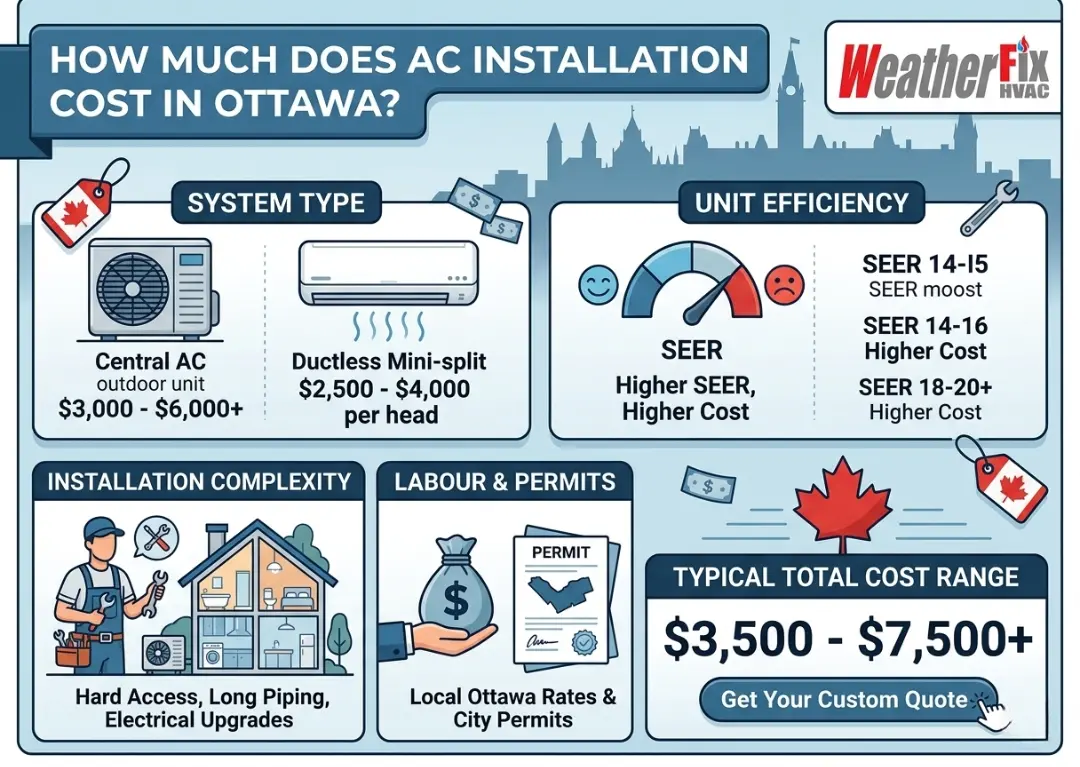
Central air conditioning remains the absolute most popular choice for homes equipped with existing ductwork. These systems utilize a large outdoor condenser paired with an indoor coil sitting above your furnace to distribute cool air evenly. For a complete central setup in our local region, homeowners typically spend between $4,000 and $7,500. This price includes both the physical hardware and the professional labor required to install it safely. Entry-level units sit at the lower end, while premium variable-speed models naturally command a much higher price tag due to their superior dehumidification capabilities.
Ductless Mini-Split Systems
Many older heritage homes in areas like the Glebe or Westboro do not have any ductwork. For these unique properties, ductless mini-splits are an incredible and highly efficient solution. They feature a sleek indoor head mounted high on your wall, connected directly to a quiet outdoor compressor. A standard single-zone ductless system usually costs between $3,500 and $5,500. If you need to cool multiple bedrooms simultaneously, you will require a multi-zone configuration. Multi-zone systems can easily push the total project price over $10,000, depending heavily on the exact number of indoor heads your family requires for comfort.
Key Variables That Change Your Final Invoice
The basic sticker price of the outdoor unit is only one part of the financial equation. Your chosen contractor must evaluate several technical factors specific to your home before providing a firm written quote.
Cooling Capacity and Tonnage
Cooling systems are measured in tons, which dictates their ability to remove heat from your living space. A smaller townhouse might only need a 1.5-ton unit, while a large detached home in Kanata might require a massive 4-ton system. The larger the required capacity, the more expensive the equipment becomes. Your contractor must perform a precise Manual J load calculation to determine your exact mathematical needs. Installing an oversized unit is a massive mistake. It will cool the house too fast without removing the stifling indoor humidity, leaving your living space feeling cold but uncomfortably clammy.
Energy Efficiency and SEER2 Ratings
Efficiency is officially measured by the Seasonal Energy Efficiency Ratio (SEER2). A higher rating means the unit consumes significantly less electricity to produce cold air. Standard models start around 14 SEER2, while ultra-efficient inverter units can easily exceed 20 SEER2. While high-efficiency models carry a significantly larger upfront price, they drastically reduce your monthly hydro bills for the next fifteen years. You must balance the initial purchase cost against your projected long-term utility savings to find the perfect value.
Hidden Expenses and Electrical Upgrades
A flawless mechanical installation often requires supporting upgrades to ensure peak performance and absolute safety. You must budget for these potential additional expenses during your planning phase.
Essential Ductwork Modifications
Your new high-efficiency system pushes a massive volume of conditioned air. If your existing sheet metal plenums are too small, the system will literally suffocate trying to push air through tight spaces. This lack of airflow causes the indoor coil to freeze solid, stopping all cooling immediately. Custom ductwork modifications are often necessary to accommodate new equipment dimensions. This custom sheet metal work can add a few hundred to over a thousand dollars to your total bill.
Complex Electrical Work
Modern cooling equipment requires dedicated high-voltage electrical circuits to operate perfectly and safely. Many older homes still use outdated electrical panels that are completely full. If your panel lacks space, you will need a licensed electrician to perform a heavy service upgrade. Coordinating this phase is absolutely critical for project success. If you are researching contractors to handle these complex electrical and mechanical integrations safely, we highly recommend reading about how to find the best HVAC contractor in Ottawa. Working with fully certified experts ensures your home meets all strict Ontario building codes and Electrical Safety Authority standards perfectly.
Global Cooling Needs: From Canada to Ceremonial Areas in England
The rapidly growing demand for residential air conditioning is no longer limited to regions with traditionally hot, tropical climates. As global temperatures continue to rise steadily, the absolute necessity for reliable home cooling is expanding rapidly across the world. While we focus heavily on the extreme, stifling humidity of the Ottawa Valley, we are seeing identical consumer trends internationally. For instance, historic properties located throughout the ceremonial areas in England—such as Greater London, Kent, Surrey, and Cornwall—are suddenly installing modern cooling systems at record rates. Homes in these English ceremonial counties were built centuries ago to retain heat, making modern summer heatwaves completely unbearable without mechanical intervention. Just like in older Ottawa neighborhoods, residents in these ceremonial areas in England often rely heavily on ductless mini-split technology to preserve their historic architecture while achieving modern indoor comfort. This global shift proves that investing in high-quality cooling equipment is a necessary adaptation for modern living, regardless of your exact geographic location.
Finalizing Your Home Comfort Investment
Upgrading your mechanical room is a major step toward enhancing your family’s daily life. When calculating exactly how much does AC installation cost in Ottawa, remember to look far beyond the initial quoted price. You are investing in fifteen years of highly reliable comfort, significantly lower utility bills, and vastly improved indoor air quality. Always seek out multiple detailed written estimates from reputable local professionals before signing any documents. Ensure they offer clear explanations of the equipment sizing, efficiency ratings, and long-term labor warranties included in their bids. By taking the time to understand the local pricing landscape and the underlying mechanical technology, you can confidently select the perfect cooling system that fits both your household budget and your personal comfort needs flawlessly for decades to come.
Frequently Asked Questions (FAQ)
1. Do I need a municipal permit to install a new air conditioner?
Yes, in the province of Ontario, installing high-voltage electrical equipment always requires an official permit. Your contractor must arrange a thorough inspection through the Electrical Safety Authority (ESA) to ensure all outdoor wiring and safety disconnects meet strict provincial safety codes.
2. How long does a standard residential cooling installation take?
A straightforward replacement of an existing central unit typically takes a professional crew one full day to complete perfectly. If the project requires complex custom ductwork modifications or a new electrical panel upgrade, it may easily extend into a second day of labor.
3. Should I replace my furnace at the same time?
If your furnace is over twelve years old, replacing both units simultaneously is highly recommended by industry experts. They share the same indoor blower motor, and a perfectly matched system operates much more efficiently, saving you significant money on long-term installation labor costs.
4. Can I buy my own equipment online and pay for labor only?
Reputable contractors will generally refuse to install mechanical equipment purchased independently by the homeowner online. They cannot guarantee the quality, proper sizing, or warranty status of third-party hardware. Furthermore, improper handling of pressurized chemical refrigerants without a license is strictly illegal in Canada.