

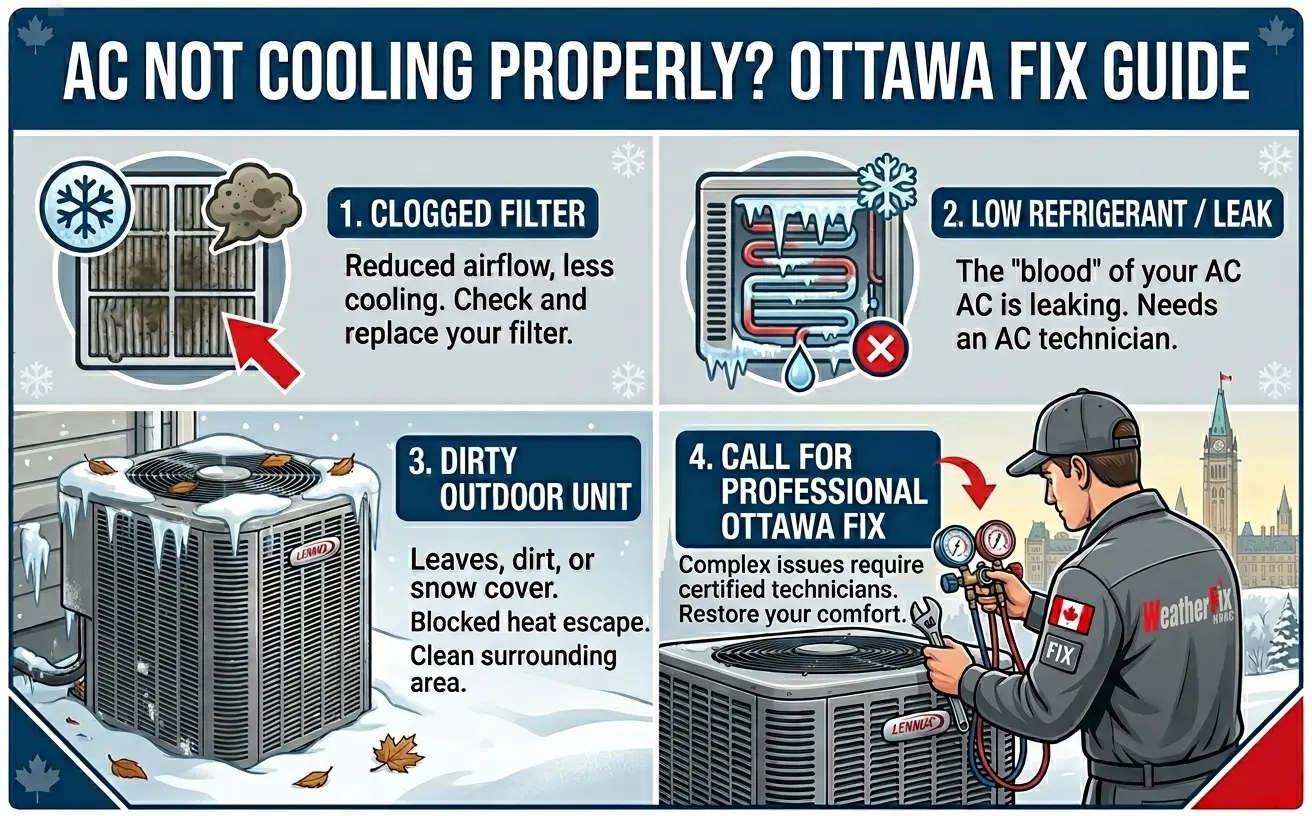
Ottawa summers are notoriously relentless. When the humidex skyrockets and the Valley air turns thick and sticky, your central air conditioning system transforms from a simple luxury into an absolute survival tool. There is nothing quite as frustrating as hearing your outdoor condenser kick on, only to feel lukewarm air weakly pushing through your vents. If you are sweating inside your own living room, you are likely desperately searching for an AC not cooling properly Ottawa fix. You are certainly not alone. Every July, our dispatch lines at WeatherFix HVAC light up with this exact complaint from frustrated homeowners.
Fortunately, while some cooling failures require complex mechanical interventions and expensive parts, many common issues can be diagnosed and even resolved with a little bit of homeowner know-how.
Why Your System is Blowing Warm Air
Understanding the basic mechanics of your residential cooling system helps pinpoint the root cause of the sudden failure. An air conditioner does not actually “make” cold air out of nothing. Instead, it operates on the principles of thermodynamics by absorbing the ambient heat and humidity from inside your home and transferring it outside, leaving the newly chilled air to circulate back through your ductwork. When this delicate heat transfer cycle is interrupted by a mechanical failure or a blockage, the system completely fails to lower the indoor temperature. Let us explore the most frequent culprits that disrupt this critical process.
The Most Common Offender: A Clogged Air Filter
If there is one piece of advice every single HVAC technician wishes homeowners would follow religiously, it is this: check your air filter regularly. Your furnace filter is the primary gatekeeper of your entire mechanical system. Its primary job is to catch dust, pet dander, pollen, and airborne debris before they can coat the sensitive internal components of your blower motor and your indoor evaporator coil.
When a standard filter becomes completely caked in thick dust, it acts like a solid brick wall. The blower motor struggles immensely to pull air through the blockage, causing the entire system to essentially suffocate. This severe lack of airflow prevents the indoor evaporator coil from absorbing heat, often resulting in the coil freezing into a solid block of ice. If you are looking for the absolute fastest and cheapest resolution to your cooling woes, swapping out a filthy filter is often the magic bullet. We highly recommend checking your filter every thirty days during peak Ottawa heatwaves, especially if you have shedding pets in the house.
Thermostat Mishaps and Ghost Settings
Sometimes, the heavy mechanical equipment itself is functioning perfectly, but the brain controlling it is confused or malfunctioning. Thermostats are notorious for causing false alarms and unnecessary panic. Before you worry about a massive repair bill, verify your wall settings carefully.
Quick Checklist for Thermostats:
- Ensure the system is explicitly set to the “Cool” mode and not accidentally bumped to “Heat” or “Fan Only.”
- Check the battery indicator on the digital display. A dying battery can cause the screen to look perfectly normal but fail to send the necessary voltage signal to engage the outdoor compressor.
- Look at the thermostat’s physical location on the wall. If it is sitting in direct sunlight through a window or positioned right next to a hot kitchen oven, it will read a false high temperature, causing the system to run erratically and waste electricity.
A Blocked Outdoor Condenser Unit
Take a quick walk outside and inspect your large metal condenser unit sitting in your yard. This crucial piece of equipment is responsible for venting the heat absorbed from your house into the outdoor Ottawa air. To perform this heat rejection efficiently, it requires a massive volume of unobstructed airflow constantly pulling through its metal side panels.
If your condenser is buried behind overgrown cedar hedges, choked by tall garden weeds, or covered in a thick blanket of sticky cottonwood seeds, it cannot “breathe” properly. The trapped heat causes the internal compressor to overheat rapidly and eventually trip its high-pressure safety switch to prevent a total meltdown. Clearing a two-foot perimeter entirely around the unit and gently rinsing the delicate metal fins with a standard garden hose can drastically improve performance and restore your cooling capacity immediately.
Advanced Issues Requiring an AC Not Cooling Properly Ottawa Fix
While dirty filters, blocked condensers, and dead thermostat batteries are easy weekend DIY projects, some cooling failures are deeply mechanical. These severe issues require specialized diagnostic tools, provincial safety certifications, and a deep understanding of pressurized thermodynamics to resolve safely. When you encounter these specific symptoms, a professional AC not cooling properly Ottawa fix is mandatory to prevent permanent equipment damage.
Low Refrigerant and Hidden System Leaks
Refrigerant is the chemical lifeblood of your air conditioner. It flows continuously in a tightly closed loop between your indoor and outdoor coils, changing constantly from a liquid to a gas to absorb and release heat. A massive misconception in the residential HVAC world is that air conditioners slowly “consume” or “use up” refrigerant over time like a car uses gas. This is entirely false.
If your system is genuinely low on refrigerant, you have a physical leak somewhere in the copper lines, the indoor evaporator coil, or the outdoor condenser. Simply “topping off” the system with new gas without finding and brazing the physical leak is a massive waste of your money and terrible for the global environment. Signs of a refrigerant leak include a distinct hissing or bubbling sound near the indoor unit, visible ice buildup on the thick copper refrigerant lines, and significantly longer cooling cycles that fail to drop the room temperature. Because modern refrigerants are highly pressurized chemicals, handling them legally requires an official ODP (Ozone Depletion Prevention) certification in Ontario.
The Dreaded Frozen Evaporator Coil
It sounds completely counterintuitive to most homeowners: how can an air conditioner be frozen solid with ice but fail to cool the living room? The indoor evaporator coil relies on a constant, heavy stream of warm return air from your house to keep its temperature completely stable. If that vital airflow is severely restricted (due to a dirty filter, collapsed flexible ductwork, or a failing blower motor), the surface temperature of the coil drops rapidly below the freezing point. The natural humidity and condensation in the air then freeze instantly to the metal fins, eventually encasing the entire indoor coil in a thick block of solid ice.
If you suspect your coil is frozen, turn the thermostat setting from “Cool” to “Off” immediately, but turn the fan setting to “On.” This forces warm house air over the ice block to thaw it safely and slowly. Never try to chip the ice away with a screwdriver or tool, as you will easily puncture the delicate pressurized coils, destroying the unit. Once it is fully thawed, you must call a technician to diagnose exactly why the airflow failed in the first place.
Failing Compressors and Blown Capacitors
The compressor is the heavy-duty engine of your outdoor unit. It heavily pressurizes the refrigerant gas and forces it through the entire system. If the compressor fails mechanically, your system is completely dead in the water. However, before condemning a highly expensive compressor and suggesting a full replacement, a skilled technician will always check the dual-run capacitor first.
The capacitor is a small, cylindrical electrical component that stores a massive electrical charge. It acts exactly like a giant battery, delivering a powerful jolt of high-voltage electricity to “jump-start” the heavy compressor and the condenser fan motor every single time the cooling cycle begins. These capacitors endure extreme thermal stress during Ottawa heatwaves and frequently burn out or swell up. A blown capacitor will often cause the outdoor unit to make a loud buzzing or humming sound while the fan blades remain completely stationary. Replacing a blown capacitor is a fast, highly affordable repair that instantly brings the entire cooling system back to life.
Step-by-Step Homeowner Troubleshooting Guide
Before you pick up the phone to book a costly emergency service call, run through this basic diagnostic checklist. You might easily save yourself the cost of a diagnostic fee by catching a simple oversight.
- Verify the Breaker Panel: Massive power surges during summer thunderstorms frequently trip the dedicated high-voltage breaker for your AC. Check your main basement electrical panel. If the AC breaker is tripped, push it fully off, then reset it firmly once. If it trips a second time immediately, stop touching it. You have a direct electrical short that requires professional safety attention.
- Inspect the Furnace Switch: Your indoor furnace (which houses the blower motor for your AC) has a standard wall light switch mounted on its side or nearby wall. This acts as a vital service disconnect for technicians. Make sure no one accidentally bumped it to the “Off” position while moving boxes or retrieving items from the basement storage.
- Assess Your Indoor Vents: Walk systematically through your home and ensure all supply registers and return air grilles are completely open and unobstructed. Blocking vents with heavy furniture, thick rugs, or curtains creates massive back-pressure in your ductwork, throwing the entire system out of balance and freezing the coil.
- Listen to the Outdoor Unit: Is the top fan spinning quickly? Do you hear the distinct low, steady hum of the internal compressor running? If the fan is spinning fast but the air blowing out of the top feels cool instead of warm, the heat transfer process is actively failing, indicating a deeper mechanical fault inside the sealed system.
When to Call the Ottawa HVAC Experts
When you have completely exhausted the basic homeowner checks and the house remains uncomfortably warm, it is time to bring in the heavy mechanical artillery. Delaying a necessary professional repair often leads to catastrophic component failure. For example, forcing a system to run daily with critically low refrigerant will eventually cause the expensive compressor to overheat and seize completely, turning a highly manageable repair bill into a massive, unexpected replacement project.
Finding a trustworthy local company is absolutely critical for your peace of mind. You want a dedicated team that prioritizes honest mechanical diagnostics over high-pressure sales tactics. If you are entirely unsure how to properly vet local professionals, take a moment to read this excellent comprehensive guide on how to find the best HVAC contractor in Ottawa. It highlights the absolute importance of verifying provincial trade licenses, checking TSSA safety certifications, and demanding transparent, upfront written pricing before any work begins.
At WeatherFix HVAC, we believe deeply in long-term, reliable solutions. Whether you desperately need a complex refrigerant leak repair, a simple electrical capacitor swap, or are looking into proactive AC maintenance in Ottawa to prevent future emergency breakdowns, our highly trained, licensed technicians are ready to restore your home’s comfort safely and efficiently.
Frequently Asked Questions (FAQ)
How long does it take for an AC to cool a house down?
It depends entirely on the total square footage of your home, the quality of your insulation, and the starting indoor temperature. Generally, a properly sized central air conditioner should be able to drop the indoor temperature by about one degree Celsius every forty-five to sixty minutes. If your system runs continuously for several hours without making a noticeable dent in the thermostat temperature, it is struggling mechanically and needs an inspection.
Why is my air conditioner blowing cold air but the house is still hot?
This is a classic symptom of incredibly poor airflow or severe ductwork leaks. The air coming directly off the indoor coil might be perfectly cold, but if your ductwork has massive disconnected gaps in the attic or crawlspace, that chilled air is escaping outside before it ever reaches your living room. Alternatively, your system might simply be drastically undersized for the total square footage of your newly renovated home.
Can I run my air conditioner while it is frozen?
Absolutely not. If you notice thick ice building up on the copper lines outside or the indoor coil, turn the cooling function off at the thermostat immediately. Running a frozen system forces the compressor to pump raw liquid refrigerant instead of a gas, a highly destructive condition known as “liquid slugging.” This will quickly destroy the delicate internal valves of the compressor, leading to a massive, unavoidable repair bill.
How often should I schedule professional maintenance?
To keep your system running flawlessly through the brutal Ottawa summer heatwaves, you should schedule a comprehensive professional tune-up once a year, ideally in the early spring before the extreme heat arrives. Annual maintenance catches failing electrical components early, clears blocked condensate drain lines, and ensures your system operates at peak factory efficiency, saving you significant money on your monthly hydro bills.