
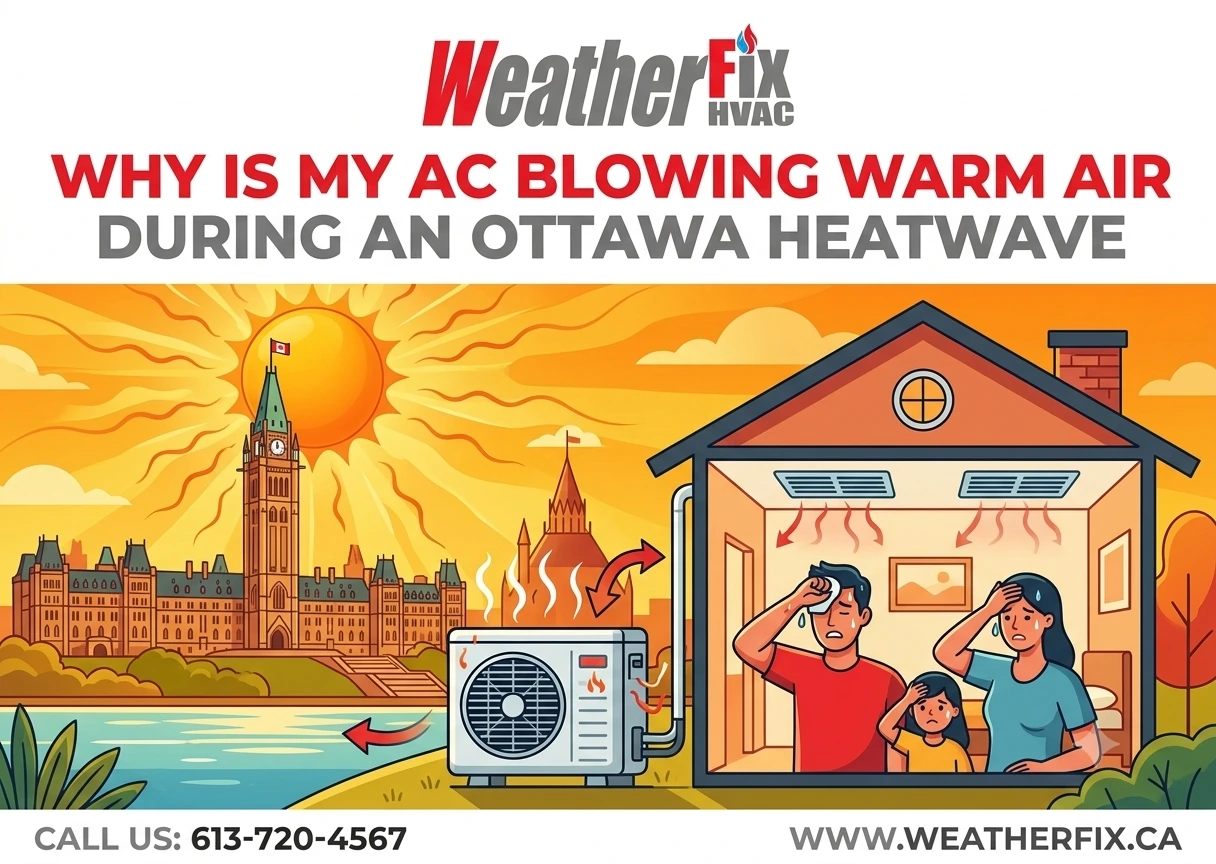
The Ottawa Valley is famous for its beautiful summers, but when late July arrives, the notorious “humidity bowl” effect turns the local climate into a sweltering, sticky challenge. When temperatures soar above thirty degrees Celsius, your home’s central cooling system becomes your ultimate sanctuary. There is nothing quite as panic-inducing as walking into your living room, hearing your outdoor unit running, and realizing the vents are pushing out lukewarm air. If you find yourself desperately Googling, “Why Is My Air Conditioner Blowing Warm Air During an Ottawa Heatwave?” you are certainly not alone. Every summer, the dispatch lines at WeatherFix HVAC light up with this exact frustrating scenario as families scramble to book an emergency air conditioner repair in Ottawa.
While feeling warm air from your vents during a severe heatwave feels like an absolute mechanical emergency, the root cause is not always a catastrophic failure. Sometimes, the issue is a simple oversight that you can resolve yourself in five minutes. Other times, it is a complex mechanical failure requiring professional diagnostic tools. This comprehensive guide will walk you through the most common reasons your AC is blowing warm air, step-by-step troubleshooting you can safely perform at home, and exactly when it is time to skip the DIY and schedule professional AC maintenance in Ottawa with our local experts.
Common Reasons Your AC is Blowing Warm Air
Before you assume your expensive compressor has died and you need a massive home renovation, it is crucial to understand the basic mechanics of your cooling system. Air conditioners do not magically create cold air; they absorb the heat from inside your Ottawa home and exhaust it outside. When this delicate heat transfer cycle is interrupted, the system simply recirculates the existing warm air. Here are the most frequent culprits.
Incorrect Thermostat Settings
It sounds incredibly simple, but you would be amazed at how many emergency service calls we run in neighborhoods like Kanata and Orleans that end with a flip of a switch. Thermostats are the “brain” of your heating and cooling system, and they can easily be bumped or misconfigured.
First, ensure your thermostat is explicitly set to “Cool” and not accidentally switched to “Heat.” Next, check the fan setting. If your fan is set to “On” rather than “Auto,” the indoor blower motor will run continuously, 24 hours a day, even when the outdoor condenser unit is actively resting between cooling cycles. During these resting periods, the system will blow unconditioned, warm room air through your vents. Simply switching the fan back to “Auto” ensures air only flows when the system is actively chilling it. Lastly, if you have a digital thermostat with a blank or flickering screen, replace the batteries. A weak battery can cause the thermostat to lose its connection with the outdoor compressor.
Severely Clogged Air Filters
If there is one piece of maintenance advice every single HVAC technician wishes homeowners would follow, it is checking the furnace filter. Your indoor air filter is the primary gatekeeper for your entire mechanical system. Its job is to catch dust, pet dander, and pollen before it coats the sensitive internal components.
When a filter becomes completely caked in thick dust, it acts like a solid wall. The blower motor struggles immensely to pull air through this blockage. Without a constant flow of warm indoor air blowing over the indoor evaporator coil, the temperature of the coil plummets. The natural condensation on the cold metal instantly freezes, encasing the entire coil in a thick block of ice. Once the coil is frozen solid, air cannot pass through it to be cooled, resulting in weak, warm air coming from your vents. Checking and replacing your filter every thirty to sixty days during peak Ottawa heatwaves is the easiest way to prevent this issue.
Tripped Electrical Circuit Breakers
Your central air conditioning system consists of two main parts: the indoor air handler (usually your furnace) and the outdoor condenser unit. These two components operate on completely separate high-voltage electrical circuits.
During intense summer thunderstorms in the Ottawa area, sudden power surges are incredibly common. It is entirely possible for the circuit breaker controlling your outdoor condenser to trip, while the breaker for your indoor furnace remains on. If this happens, your indoor fan will continue to blow air through the ductwork, but because the outdoor unit is receiving zero electricity, the air will not be cooled. Head down to your basement electrical panel and look for the breaker labeled “AC” or “Condenser.” If it is tripped, flip it firmly to the “Off” position, and then back to “On.” If it trips again immediately, stop touching it—you have a serious electrical short that requires a professional.
How to Fix an Air Conditioner Not Cooling
If you have verified your thermostat is correct, your filter is clean, and your breakers are on, but you are still asking yourself why your AC is blowing warm air, it is time to dig a little deeper. Here are a few safe troubleshooting steps you can perform before calling WeatherFix.
Thawing a Frozen Evaporator Coil
If you suspect poor airflow caused your system to freeze (perhaps you just pulled out a severely clogged filter), you must thaw the system completely before it can cool again. Go to your thermostat, switch the system setting from “Cool” to “Off,” and turn the fan setting from “Auto” to “On.” This forces the warm air from your house to blow continuously over the block of ice, thawing it safely.
This process can take anywhere from a few hours to an entire day depending on the severity of the ice buildup. Never attempt to chip the ice away with a screwdriver or a sharp tool. The internal copper coils are incredibly delicate and highly pressurized; puncturing one will destroy the unit instantly. Once the ice is completely melted, put in a fresh filter and turn the cooling back on. If it freezes again, you have a deeper mechanical issue.
Clearing the Outdoor Condenser Unit
Take a walk outside and physically inspect your large metal condenser unit. This piece of equipment is responsible for venting the massive amount of heat absorbed from your house into the outdoor air. To perform this heat rejection efficiently, it requires an unobstructed flow of air pulling through its metal side panels.
If your condenser is buried behind overgrown cedar hedges, choked by tall garden weeds, or covered in a thick blanket of sticky cottonwood seeds (a very common issue in Ottawa suburbs), it cannot “breathe” properly. The trapped heat causes the internal compressor to overheat rapidly. To protect itself from a total meltdown, the system will trip an internal high-pressure safety switch and shut down the cooling process, leaving your indoor fan to blow warm air. Clearing a two-foot perimeter entirely around the unit and gently rinsing the delicate metal fins with a standard garden hose can drastically improve performance.
When to Call an Ottawa HVAC Expert for AC Repairs
When you have exhausted the basic homeowner checklist and the house remains uncomfortably warm, it is time to bring in the licensed mechanical professionals. Attempting to fix complex electrical or chemical issues yourself is not only dangerous, but it is strictly illegal in Ontario without the proper trade licenses.
Diagnosing Low Refrigerant and Hidden Leaks
A massive misconception in the residential HVAC world is that air conditioners slowly “consume” or “use up” refrigerant over time. This is entirely false. Refrigerant operates in a tightly sealed, closed-loop pressurized system. If your system is low on refrigerant, you have a physical, leaking hole in your expensive copper lines.
When refrigerant levels drop, the pressure inside the system changes, which usually results in a completely frozen indoor coil and warm air blowing from your vents. Simply “topping off” the system with new gas without finding and brazing the physical leak is a massive waste of your money. Because modern refrigerants are highly pressurized chemicals, handling them legally requires an official ODP (Ozone Depletion Prevention) certification. If you suspect a leak, booking professional diagnostics is your only safe course of action.
Repairing Failing Compressors and Electrical Capacitors
If you hear a loud buzzing or humming sound coming from your outdoor unit, but the fan blades are perfectly still, you likely have a blown dual-run capacitor. The capacitor acts like a giant battery, delivering a powerful high-voltage jolt to “jump-start” the heavy compressor and the fan motor. These components endure extreme thermal stress during Ottawa heatwaves and frequently burn out. Replacing a capacitor is a highly affordable, fast repair.
However, if the compressor itself has mechanically seized and failed, the repair becomes much more extensive. For older systems, replacing a dead compressor often does not make financial sense. If your system is over fifteen years old, it may be time to consult with an expert about a complete AC installation in Ottawa. Modern systems offer vastly superior dehumidification capabilities for the humid Ottawa climate.
Finding a trustworthy local company is absolutely critical for your peace of mind. If you are entirely unsure how to properly vet local professionals, take a moment to read this excellent comprehensive guide on how to find the best HVAC contractor in Ottawa. It highlights the absolute importance of verifying provincial trade licenses and demanding transparent pricing before any work begins.
Protecting Your Investment with Annual Maintenance
The absolute best way to prevent the panic of your air conditioner blowing warm air during an Ottawa heatwave is through proactive, professional care. By scheduling an annual check-up every spring, our licensed WeatherFix technicians can clean your coils, test your capacitors, and verify your exact refrigerant pressures long before the July heat arrives. Consistent maintenance not only prevents unexpected breakdowns but also ensures your equipment operates at peak factory efficiency, saving you significant money on your monthly utility bills.
Frequently Asked Questions
1. How long does it take an AC to cool down a hot house?
A properly sized central air conditioner should be able to drop the indoor temperature by about one degree Celsius every forty-five to sixty minutes. If your system runs continuously for three or four hours without making a noticeable dent in the thermostat temperature, it is struggling mechanically and needs a professional inspection.
2. Can a dirty air filter really stop my AC from cooling?
Yes, absolutely. A severely clogged filter restricts the vital return airflow completely. Without warm air blowing over it, the indoor evaporator coil’s temperature drops rapidly until it freezes into a solid block of ice, halting all indoor cooling immediately and causing the vents to blow warm, unconditioned air.
3. Should I turn off my AC if it is blowing warm air?
Yes. If your system is blowing warm air and you cannot fix it by adjusting the thermostat or changing the filter, turn it off at the main thermostat immediately. Continuing to force the electrical equipment to run while internal mechanical parts are actively failing can cause catastrophic, irreversible damage to the highly expensive compressor.
4. Are there government rebates for replacing an old AC?
Yes! If your old air conditioner is beyond repair and blowing warm air permanently, you might qualify for financial incentives. Many homeowners consult resources like Natural Resources Canada to discover available government rebates for upgrading to highly efficient, eco-friendly cold-climate heat pumps.