
When sub-zero temperatures hit the Ottawa Valley, your home’s climate control transitions from a luxury to an absolute necessity. Most homeowners walk past their thermostat, adjust the dial, and enjoy the resulting warmth without giving a second thought to the complex engineering operating behind the scenes. If you have recently found yourself asking, “how does your heating system work,” you are taking the critical first step toward reducing your monthly energy bills and extending the lifespan of your equipment.
The experts at WeatherFix HVAC understand that an educated homeowner is the best line of defense against unexpected winter breakdowns. Whether your home is equipped with a high-efficiency gas furnace, a radiant boiler, or a modern cold-climate heat pump, every system relies on specific scientific principles to generate and distribute warmth.
By understanding the mechanics of your specific equipment, you can identify early warning signs of mechanical failure, optimize your energy usage, and know exactly when it is time to call for professional heating services in Ottawa.
Why Asking “How Does Your Heating System Work” Saves You Money
A heating system is the most expensive and energy-intensive appliance in your home. Understanding its basic functions provides immediate, tangible benefits:
- Lower Operating Costs: Knowing how air flows through your system encourages better filter maintenance and thermostat management, directly reducing gas and hydro consumption.
- Early Problem Detection: When you know how a system should sound and operate, you can easily spot short-cycling, unusual grinding noises, or burner ignition delays before they cause total system failure.
- Smarter Upgrade Decisions: As the Canadian government pushes for electrification, understanding the difference between combustion heat and heat transfer empowers you to make highly profitable decisions regarding future equipment upgrades.
How Does Your Heating System Work: Breaking Down the Main Technologies
To fully answer the question of how does your heating system work, we must evaluate the three primary types of residential heating equipment utilized across Kanata, Orleans, and Barrhaven.
1. Forced-Air Gas Furnaces: The Combustion Cycle
The forced-air natural gas furnace remains the most common heating appliance in Eastern Ontario. It generates heat through controlled combustion and distributes it via hidden ductwork.
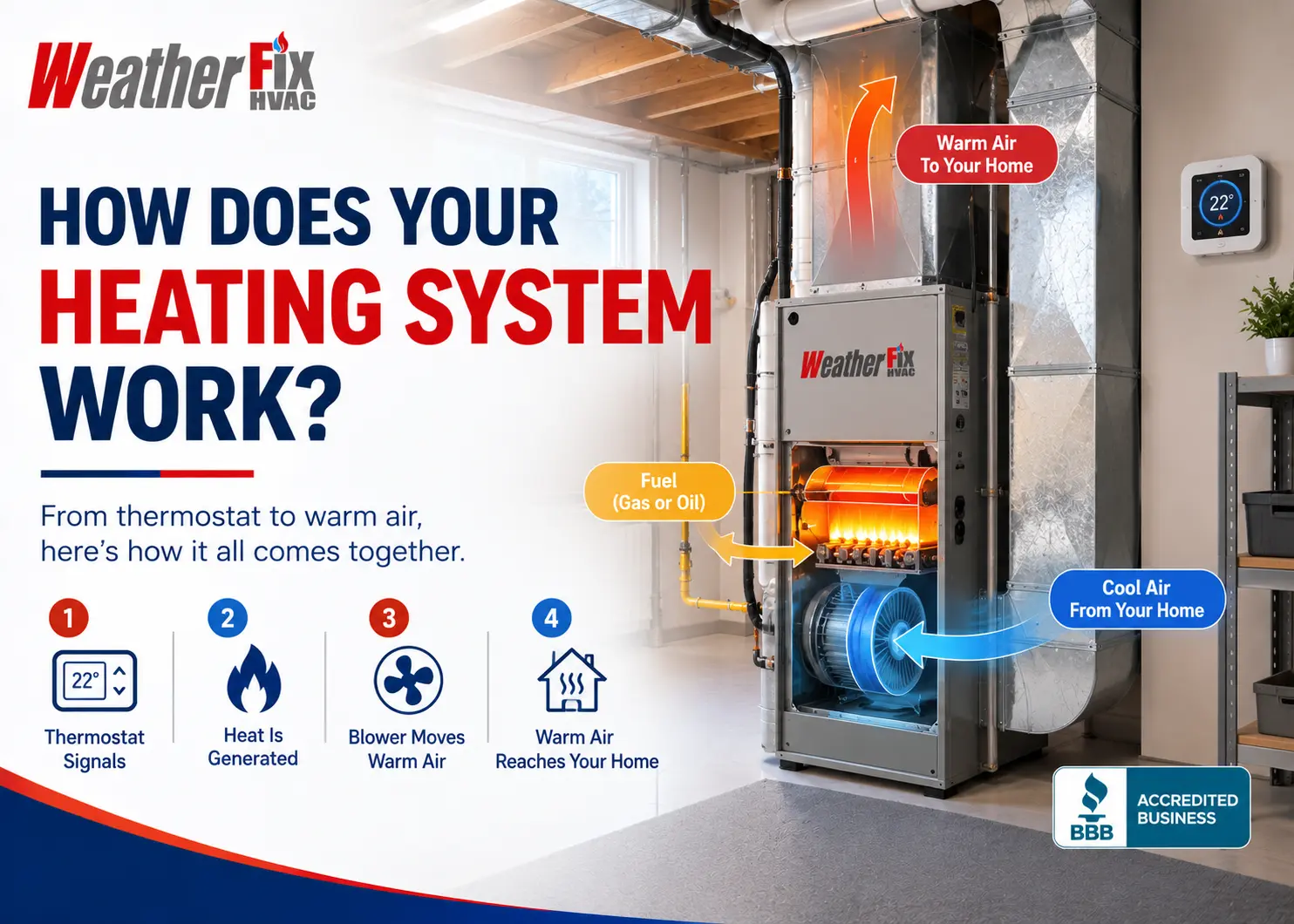
Here is exactly how does your heating system work when utilizing a gas furnace:
- The Call for Heat: Your thermostat detects a temperature drop and sends a low-voltage electrical signal to the furnace control board.
- Combustion: The inducer motor kicks on to ensure clear venting. The gas valve opens, releasing natural gas into the burner assembly, where an electronic igniter creates a controlled blue flame.
- The Heat Exchanger: The flames are drawn into a serpentine metal chamber called the heat exchanger. This metal gets blazing hot. The toxic combustion exhaust gases (including carbon monoxide) remain safely trapped inside this chamber and are eventually vented out the side of your home or up the chimney.
- Air Circulation: A powerful internal blower fan turns on, pulling cold indoor air from your return vents and forcing it over the blistering exterior of the heat exchanger. The air rapidly absorbs the thermal energy.
- Distribution: The newly heated air is pushed into your supply ducts, flowing out of the floor or ceiling registers to warm your living space.
If your older furnace is struggling to complete this cycle, exploring a high-efficiency furnace installation in Ottawa can drastically reduce the amount of fuel wasted during combustion.
2. Cold-Climate Heat Pumps: The Phase Change Process
As utility rates fluctuate and carbon taxes increase, many Ottawa residents are replacing traditional furnaces with air-source heat pumps. Instead of burning fuel to generate heat, a heat pump uses electricity to move existing thermal energy.
If you are upgrading to green technology, understanding how does your heating system work is crucial:
- Heat Extraction: Even when the Ottawa winter drops to -20°C, there is still latent heat energy in the outdoor air. The heat pump’s exterior condenser unit utilizes a specialized liquid refrigerant with an exceptionally low boiling point. As a fan pulls freezing outdoor air across the outdoor coils, the refrigerant absorbs the ambient heat and evaporates into a gas.
- Compression: A highly advanced inverter-driven compressor squeezes this gas, exponentially increasing its pressure and temperature.
- Indoor Transfer: The super-heated gas is pumped into the indoor air handler coil. Your home’s cold air is blown across this indoor coil, absorbing the heat and warming the rooms. The refrigerant then cools back into a liquid and travels outside to repeat the cycle.
Because they transfer heat rather than creating it, heat pumps operate at 300% to 400% efficiency. To learn more about this sustainable technology, check out our guide on heat pump installation in Ottawa.
3. Hydronic Boilers: Radiant Liquid Heat
Older heritage homes in the Glebe or modern custom builds often utilize boiler systems. Unlike furnaces that use forced air, boilers distribute thermal energy using water, a process known as hydronic heating.
- Heating the Water: The boiler uses natural gas, propane, or electricity to heat water inside a closed primary tank.
- Circulation: A heavy-duty circulator pump pushes the hot water through a closed loop of pipes installed behind walls, under floorboards, or connected to cast-iron radiators.
- Radiant Release: As the hot water travels through the home, the heat radiates smoothly into the rooms. The cooled water eventually returns to the boiler to be reheated.
Hydronic systems do not blow dust or allergens through the house, making them ideal for families with respiratory sensitivities.
The Vital Support Components
Regardless of whether you rely on gas combustion or electric heat transfer, your equipment relies on several vital support components to function effectively.
Thermostats: The Command Center
Your thermostat is the brain of your climate control network. It constantly monitors ambient room temperatures and dictates precisely when the mechanical equipment should cycle on and off. Modern smart thermostats optimize this process by learning your family’s schedule, tracking local weather patterns, and preventing the system from running unnecessarily when the house is empty.
Ductwork and Air Filters: The Lungs of Your Home
For forced-air systems, ductwork acts as the respiratory system. Return ducts inhale cold, stale air, while supply ducts exhale warm, conditioned air. Standing between these two extremes is your air filter.
Many homeowners overlook the filter, but it is the single most important maintenance item you can control. A clogged, dirty air filter suffocates the blower motor. This forces the system to run longer, consumes more energy, and frequently causes the heat exchanger to overheat and shut down prematurely.
How Does Your Heating System Work Better with Routine Maintenance?
Mechanical systems endure immense stress during a long Canadian winter. Moving parts lose lubrication, burners become coated in soot, and electrical connections vibrate loose over time. Even if you fully grasp how does your heating system work, it cannot operate efficiently without professional intervention.
Annual preventative maintenance is essential to keep your equipment running at peak performance. During a professional tune-up, certified technicians clean the burner assembly, test safety limit switches, measure voltage draw on the blower motor, and calibrate the thermostat. Skipping these inspections drastically increases the likelihood of a mid-winter breakdown and voids manufacturer warranties. To protect your investment, review our guidelines on how often HVAC systems should be serviced.
Trust WeatherFix HVAC for Your Winter Comfort
Understanding the intricate mechanics behind your home’s climate control system empowers you to operate your equipment efficiently and identify minor issues before they become catastrophic emergencies. The next time you walk past your thermostat and wonder exactly how does your heating system work, you will know the science keeping your family safe from the Ottawa cold.
If your current system is making strange noises, failing to keep your home warm, or causing your utility bills to skyrocket, it is time to call the local experts at WeatherFix HVAC. We provide transparent assessments, rigorous maintenance, and flawless installations tailored to your specific property.
Ready to optimize your home comfort? Contact WeatherFix HVAC today.