
In a city with a climate as demanding as Ottawa’s, HVAC (Heating, Ventilation, and Air Conditioning) professionals are essential. They are the skilled tradespeople who keep our homes warm through brutal -30°C cold snaps and comfortably cool during humid 30°C+ heatwaves. This vital role makes it a secure and rewarding career path.
But it’s not a job you can just walk into. The path of how to get an HVAC license in Ontario is a serious commitment to safety, training, and skill. It involves a formal apprenticeship and several crucial safety certifications. This guide will break down the exact steps you need to take to become a licensed HVAC technician in Ottawa.
First, Understand It’s Not Just One License
The most important thing to know is that there isn’t one single “HVAC License” in Ontario. To be a fully qualified technician, you must hold two separate types of licenses from two different governing bodies.
1. The “Trade License” (Certificate of Qualification)
This is the license for the refrigeration and air conditioning part of the job. It’s a compulsory trade, meaning you must be a registered apprentice or a certified journeyperson to work in this field.
- Governing Body: Skilled Trades Ontario (STO).
- The License: This is your Certificate of Qualification (C of Q), most commonly the 313A – Refrigeration and Air Conditioning Systems Mechanic. This license covers residential, commercial, and industrial systems. A more limited license, the 313D, is for residential systems only.
- This license allows you to: Install, service, and perform air conditioner repair in Ottawa.
2. The “Fuel License” (Gas Technician)
This is the license for the heating part of the job. Since the vast majority of furnaces in Ottawa are powered by natural gas, you cannot legally touch them without this license.
- Governing Body: The Technical Standards and Safety Authority (TSSA).
- The License: This is your Gas Technician license, most commonly the G2 (Gas Technician 2). The G2 allows you to work unsupervised on any gas-fired appliance under 400,000 BTUs (which covers all residential and light commercial equipment). You must first get your G3 (Gas Technician 3) as a trainee.
- This license allows you to: Perform a furnace installation in Ottawa or service a gas-fired water heater in Ottawa.
A professional HVAC technician holds both a 313A C of Q and a TSSA G2 license.
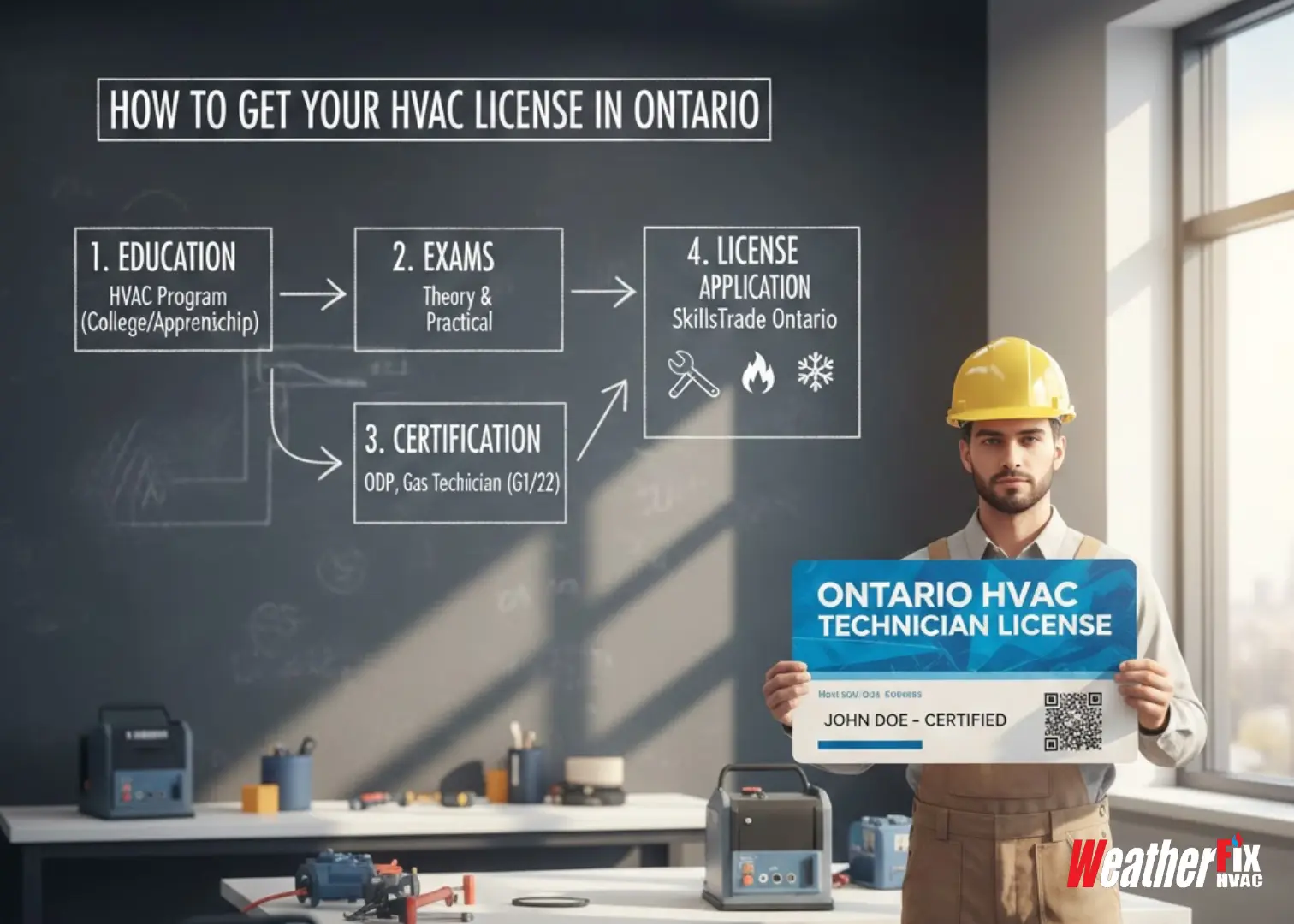
Your Step-by-Step Path: How to Get an HVAC License in Ontario
So, you’re ready to start. Here is the official path to becoming a fully certified HVAC mechanic in this province.
Step 1: Meet the Educational Requirements
Before you can begin, you need an Ontario Secondary School Diploma (OSSD) or its equivalent. Having strong grades in math and physics is a significant advantage for both your in-class training and your understanding of the complex theories behind refrigeration and combustion.
Conclusion: This foundational high school education is your non-negotiable ticket into any apprenticeship or college program.
Step 2: Choose Your Training Pathway
You have two main ways to start.
- Direct Apprenticeship: You find an Ottawa-area employer (a “sponsor”) who is willing to hire and train you as an apprentice. They will sign you up with the Ministry of Labour, Immigration, Training and Skills Development (MLITSD). You will then work and get paid while learning on the job, attending your “in-class” trade school portions in blocks.
- College-First Program: This is a very common and popular path. You enroll in a 1- or 2-year HVAC Technician program at a college like Algonquin College. This program does not give you your 313A license. Instead, it gives you a massive head start: you will get your TSSA G3 and G2 licenses, your ODP card (see below), and credit for all your in-class apprenticeship training.
Conclusion: The college-first path makes you a much more attractive hire, as companies can put you to work on gas appliances immediately.
Step 3: Register as an Apprentice
Once you have an employer, you must be registered as an apprentice with the MLITSD and Skilled Trades Ontario (STO). This officially starts your journey. You will receive a logbook to track your hours and the skills you learn. You are now officially an apprentice, earning a wage while you train.
Conclusion: This formal registration is the official start of your career and your paid path toward certification.
Step 4: Complete Your On-the-Job and In-Class Training
This is the longest part of the journey. For the 313A license, you must complete approximately 9,000 hours of training.
- On-the-Job Training (~8,160 hours): You will be working in the field alongside certified journeypersons. You’ll start with tasks like performing AC maintenance in Ottawa and eventually move on to complex diagnostics and installations.
- In-Class Training (~840 hours): You will attend trade school (like Algonquin College) for several blocks to learn the theory behind electrical systems, refrigeration cycles, and gas combustion.
Conclusion: This hybrid model is the core of the apprenticeship, ensuring you have the practical field skills and the deep theoretical knowledge of a true professional.
Step 5: Pass the Certificate of Qualification (C of Q) Exam
After you have completed all your required hours, you are eligible to write the final Certificate of Qualification exam for the 313A trade. This is a challenging, multiple-choice exam that tests your knowledge of the entire trade.
Conclusion: Passing this final exam is the milestone that officially makes you a licensed journeyperson and a certified Refrigeration and Air Conditioning Systems Mechanic.
The Other “License” You Can’t Forget: The ODP Card
In addition to your TSSA and STO licenses, you must also have an Ozone Depletion Prevention (ODP) Card. This certification is required by the Ontario government for any technician who handles, transports, or purchases refrigerants. You can typically get this by completing a one-day environmental awareness course.
Conclusion: You cannot legally perform an AC installation in Ottawa or handle refrigerant without this mandatory card.
Why Should a Homeowner Care About Licenses?
This is a critical question for any customer. Learning how to choose the right HVAC contractor always comes down to checking their credentials.
- Safety: The TSSA G2 license is your only guarantee that a technician is trained to work safely with natural gas. An unlicensed person risks gas leaks, fire, and carbon monoxide poisoning.
- Quality: The 313A Certificate of Qualification proves the technician has thousands of hours of training and has passed a rigorous exam. They know how a furnace works with an air conditioner and how to diagnose it properly.
- Insurance: A legitimate, licensed company will carry full liability insurance and WSIB coverage. This protects you and your home from any accidents or damage.
- Legality: It is illegal for an unlicensed individual to work on your gas furnace or air conditioner. If something goes wrong, your home insurance may not cover the damage.
Frequently Asked Questions (FAQ)
1. How long does it take to get an HVAC license in Ontario?
From start to finish, a 313A apprenticeship (which includes your on-the-job and in-class training) takes about five years to complete. A college program can shorten this by one to two years.
2. Can I work with just a G2 license?
You can work, but only on the gas-fired portions of the equipment. You cannot legally service the refrigeration side (the air conditioner or heat pump) without being a registered 313A or 313D apprentice or journeyperson.
3. What is the difference between TSSA and Skilled Trades Ontario (STO)?
TSSA is the safety regulator. They govern fuel safety (gas, propane) and other high-risk systems. STO is the trade regulator. They govern the apprenticeship training and certification for skilled trades like 313A. You need certifications from both.
4. How much do HVAC apprentices make in Ottawa?
Apprentice wages are a percentage of a licensed journeyperson’s wage. You start at a lower rate (e.g., 50%) and receive pay increases as you complete your hours and training blocks.
Conclusion: A Demanding but Rewarding Path
The path of how to get an HVAC license in Ontario is a challenging but secure one. It requires a long-term commitment to an apprenticeship (313A/313D) and a serious focus on safety (TSSA G2). This rigorous process ensures that the technicians working in Ottawa homes are true professionals.For those considering the career, it’s a stable and well-paying future. For homeowners, it’s a clear reminder: always hire a fully licensed and insured contractor for any heating services in Ottawa to protect your home and your family.