
In the National Capital Region, our weather is famous for its extremes. We endure sweltering, humid heatwaves in July and bone-chilling, sub-zero freezes in January. Your home’s comfort—and your family’s safety—relies entirely on the machinery sitting in your basement and beside your house. Yet, despite being the most expensive and hardworking appliance in the home, the HVAC system is often the most neglected.
Many homeowners operate on a “break-fix” mentality, only calling a technician when the furnace stops working at 2 AM on a snowy night. This approach is costly, stressful, and dangerous. The smarter approach is proactive maintenance. But how often should HVAC systems be serviced to ensure they survive the Ottawa climate?
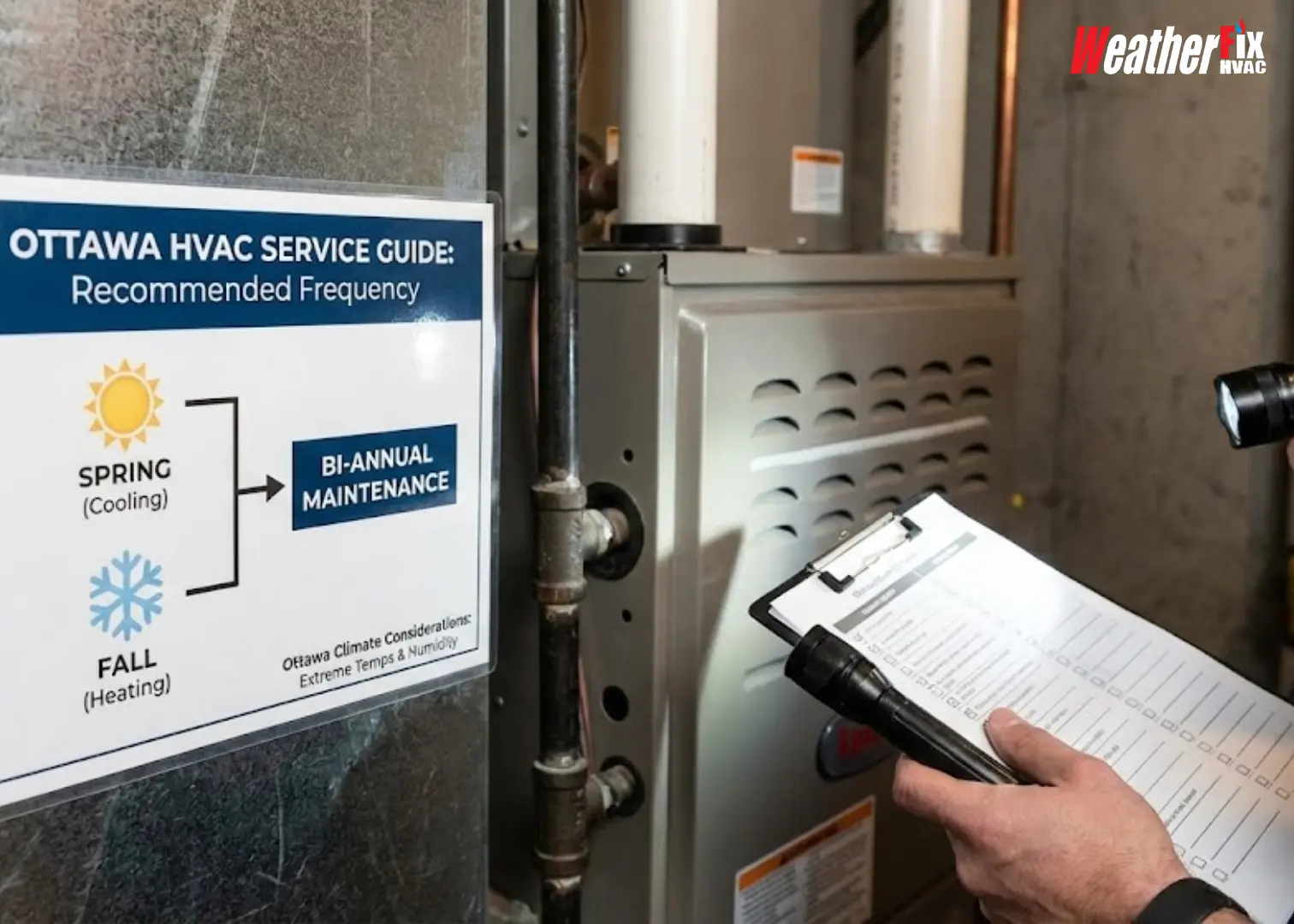
The short answer is at least once a year for each system. This means you should have your air conditioner serviced in the spring and your furnace serviced in the fall. If you have a heat pump, the schedule is even more critical. This guide will break down the ideal maintenance schedule, what happens during a professional tune-up, and why skipping it is a financial risk you shouldn’t take.
The “Two-Season” Rule: A Schedule for Ottawa Homes
Ottawa has two distinct “peak” seasons for energy usage: the heating season and the cooling season. Your maintenance schedule should mirror this. You wouldn’t drive your car for 50,000 kilometres without an oil change; you shouldn’t run your HVAC system for 2,000 hours without a tune-up.
Spring: The Cooling Tune-Up
As the snow melts and we head into April and May, it is time to think about your air conditioner. It has been sitting dormant under snow and ice for six months. Turning it on without an inspection is a gamble.
- Timing: Late April to early June.
- Goal: To ensure the condenser coil is clean (free of winter debris) and the refrigerant levels are correct before the first heatwave hits.
- Why it matters: A dirty condenser can increase your electricity bill by 30% because the unit can’t release heat efficiently.
Fall: The Heating Tune-Up
This is the most critical service of the year. In Ottawa, a furnace failure isn’t just an inconvenience; it can freeze your pipes and cause massive property damage.
- Timing: September to November.
- Goal: To verify the safety of the heat exchanger and burners.
- Why it matters: Carbon monoxide leaks are a real threat. A cracked heat exchanger often has no external symptoms but can be deadly.
The Heat Pump Exception
If you have upgraded to a heat pump, you are using one machine to do two jobs. It runs all summer to cool you and all winter to heat you.
- Frequency: Because it runs 12 months a year, many manufacturers and experts recommend a comprehensive service every 12 months, with a filter check every 3 months.
- Ottawa Factor: Heat pumps in Ottawa are prone to ice buildup and “cottonwood” clogging. They require vigilant visual inspections by the homeowner in addition to professional service.
Why “Once in a While” Isn’t Enough
You might think, “My system is running fine, why should I pay for service?” This is a common misconception. HVAC systems degrade slowly. By the time you notice a noise or a temperature drop, the damage is already done. Here is why sticking to the answer of how often should HVAC systems be serviced matters.
1. Manufacturer Warranties Demand It
Read the fine print on your furnace or AC warranty. Almost every major brand (Carrier, Lennox, Trane, etc.) contains a clause stating that the warranty is void if the equipment is not maintained annually by a licensed professional. If your compressor blows in Year 5, and you can’t prove you had it serviced, you could be on the hook for a $2,000+ repair bill.
2. Efficiency = Money in Your Pocket
A neglected system is a dirty system. Dust on the blower wheel, dirt on the outdoor coil, and a clogged filter all create resistance.
- The Cost: The system has to run longer and work harder to achieve the same temperature.
- The Savings: Regular cleaning ensures your system runs at its factory-rated SEER and AFUE efficiency, keeping your Hydro Ottawa and Enbridge bills as low as possible.
3. Extending the Lifespan
The average life of a furnace in Ottawa is 15–18 years. The average life of an AC is 12–15 years. However, neglected systems often fail around the 10-year mark due to overheating and strain. Regular maintenance lubricates moving parts and tightens electrical connections, adding years of life to your expensive investment.
What Actually Happens During a Service Visit?
A proper tune-up is not just a guy shining a flashlight into your furnace. It is a comprehensive inspection and cleaning process. When you hire Weatherfix for your maintenance, here is what you should expect.
The Furnace Maintenance Checklist (Fall)
When we service your heating system, our primary focus is safety and combustion efficiency.
- Safety Check: We inspect the heat exchanger for cracks (the #1 source of carbon monoxide leaks). We also test the high-limit switch to ensure the furnace shuts down if it overheats.
- Burner Cleaning: We remove rust and soot from the burners to ensure a clean, blue flame. A yellow flame indicates incomplete combustion and wasted fuel.
- Ignitor & Flame Sensor: We clean the flame sensor (which often gets coated in carbon) to prevent the furnace from shutting down randomly.
- Blower Motor: We check the amp draw of the motor and check the capacitor. If the capacitor is weak, changing it now prevents a mid-winter breakdown.
- Venting: We inspect the exhaust flue to ensure it is clear of birds’ nests, leaves, or ice blockages.
The Air Conditioner Maintenance Checklist (Spring)
When we perform AC maintenance in Ottawa, our focus is on airflow and heat rejection.
- Condenser Cleaning: This is the big one. We wash the outdoor fins to remove the “blanket” of dust, pollen, and cottonwood fluff that suffocates the unit.
- Refrigerant Check: We measure the pressure and subcooling of the system. Even a small leak can freeze up the coil and destroy the compressor.
- Electrical Tightening: Vibrations loosen wires over time. We tighten all connections to prevent arcing and electrical failures.
- Drain Line Flush: We clear the condensate drain to prevent water from backing up and leaking into your basement.
DIY Maintenance vs. Professional Service
While the answer to how often should HVAC systems be serviced by a pro is twice a year, there are things you must do yourself in between visits.
Your Monthly Task: The Filter
The single most important thing a homeowner can do is change the air filter.
- 1-Inch Filters: Change every 1–2 months.
- 4-Inch Media Filters: Change every 4–6 months.
- Why: A clogged filter restricts airflow. This can cause your furnace to overheat and shut down (limiting) or cause your air conditioner coil to turn into a block of ice.
Your Seasonal Task: Outdoor Clearance
Go outside and look at your unit.
- Summer: Keep tall grass, weeds, and shrubs at least 24 inches away from the AC unit. It needs to breathe.
- Winter: Ensure your furnace exhaust pipes (the white PVC pipes poking out of your wall) are not buried in a snowdrift. Blocked pipes will shut your furnace down instantly for safety reasons.
The Cost of Neglect: A Real-World Ottawa Scenario
Imagine it is February. It is -25°C. You ignored the fall maintenance. Your flame sensor, dirty from years of use, finally stops detecting the flame. Your furnace shuts down.
- The Emergency: You wake up to a freezing house. You call for emergency service.
- The Bill: You pay an emergency dispatch fee, plus the cost of the repair.
- The Risk: If the technician is booked solid (which happens during cold snaps), you might be waiting hours or days with space heaters, risking frozen pipes.
Compare this to a scheduled maintenance visit in October. The technician would have cleaned that sensor in 5 minutes as part of the standard fee. The breakdown would never have happened. This peace of mind is why we always recommend our clients be proactive with their heating services in Ottawa.
Hiring the Right Team
Not all tune-ups are created equal. Some “discount” offers are just loss-leaders designed to get a salesperson into your home to sell you a new unit. When looking for service:
- Check Credentials: Ensure the technician is TSSA licensed (for gas) and 313A/313D certified (for AC).
- Ask for a Checklist: A reputable company will provide a written report of what was checked, including readings for voltage, amps, and refrigerant pressures.
- Look for Honesty: If they find a problem, ask them to show it to you. A good tech will explain why a part needs replacing, not just tell you to do it.
For trustworthy service, whether it’s a routine check or a complex furnace installation in Ottawa, Weatherfix is here to help. We believe in transparency and building long-term relationships with our clients.
Conclusion: Mark Your Calendar
So, how often should HVAC systems be serviced? Put it in your calendar right now: Spring for Cooling, Fall for Heating.
Treat your HVAC system with the same respect you give your car. It is a complex machine that keeps your family safe and comfortable through the harsh Ottawa climate. Regular professional maintenance pays for itself in lower energy bills, fewer repairs, and a longer system life. Don’t wait for the breakdown—schedule your service today and enjoy worry-free comfort all year round.
If you are unsure when your system was last checked, or if you need to book an appointment, contact our expert team. From air conditioner repair in Ottawa to heat pump solutions, we have you covered.
Frequently Asked Questions (FAQ)
1. Does a new HVAC system really need maintenance every year?
Yes, absolutely. In fact, new systems need it just as much as old ones, primarily to protect the warranty. Manufacturers like Carrier and Lennox often require proof of annual maintenance to honor their parts warranties. If a part fails in year two and you haven’t had it serviced, they may deny the claim.
2. Can I perform the maintenance myself?
You can perform some maintenance, such as changing the air filter and keeping the outdoor unit clear of debris and snow. However, you cannot perform the critical safety and technical checks. You do not have the tools to test refrigerant pressure, measure gas manifold pressure, or detect invisible cracks in a heat exchanger. These tasks require a licensed professional.
3. How long does a service appointment take?
A thorough professional tune-up typically takes between 60 to 90 minutes. If a technician is in and out in 15 minutes, they likely didn’t perform a full inspection. They need time to test the system through a full cycle, clean the components, and measure electrical readings.
4. What is the best month to schedule furnace maintenance in Ottawa?
September or October is ideal. You want to have the system checked before the first deep freeze hits. Once November and December arrive, HVAC companies are often swamped with emergency no-heat calls, making it harder to book a routine maintenance slot.