

In the Ottawa Valley, winter is not a suggestion; it is a force of nature. When the temperature at the airport hits -25°C and the wind chill pushes it toward -35°C, most homeowners trust nothing but a roaring natural gas furnace to keep them alive. For decades, the common wisdom was simple: “Heat pumps are for mild climates. They don’t work in Canada.”
That wisdom is now obsolete.
Today, you will see heat pumps humming away on the side of homes in Manotick, Kanata, and Orléans, even in the dead of February. But how is this possible? How can a machine extract heat from air that feels like it freezes your lungs instantly? Understanding how heat pumps work in cold climates requires looking past our human perception of “cold” and diving into the physics of thermodynamics.
This guide will break down the science behind the machinery, explain the “magic” of modern refrigerants, and show you exactly why these systems are now a viable, efficient primary heat source for Ottawa homes.
How Heat Pumps Work in Cold Climates: The Physics of Heat
To a human, -20°C feels incredibly cold. To a physicist, it is actually quite warm.
This is the fundamental secret. Heat energy exists in all air down to “Absolute Zero,” which is -273.15°C (0 Kelvin). As long as the air outside is warmer than -273°C, there is thermal energy waiting to be harvested. Even on Ottawa’s coldest recorded day in history, the air was packed with heat energy—we just couldn’t feel it.
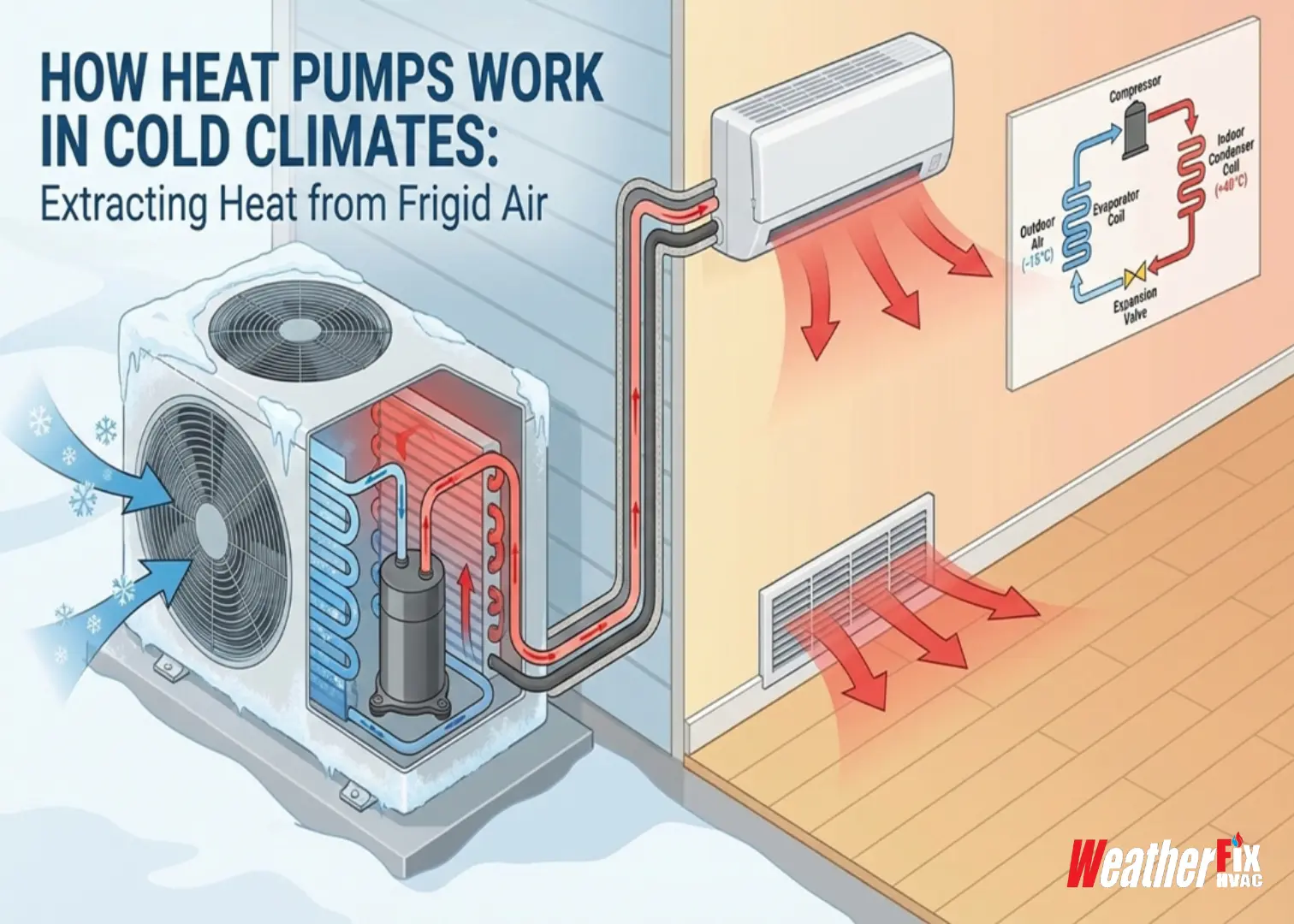
A heat pump doesn’t create heat like a furnace (which burns gas to make fire). Instead, it acts like a sponge. It absorbs that hidden thermal energy from the outdoor air, concentrates it, and releases it inside your home. It moves heat from a cold place to a warm place, which seems to defy nature, but is made possible by the refrigeration cycle.
The “Magic” of Phase Change
The engine of this process is the refrigerant (typically R-410A or the newer R-454B). This fluid has a boiling point far lower than water.
- Water boils at: +100°C.
- R-410A refrigerant boils at: -48.5°C.
Think about that number. At -30°C, this refrigerant is still hot enough to boil. When the liquid refrigerant flows through the outdoor coil, the “warm” -30°C winter air passes over it. Because the air is warmer than the fluid’s boiling point, the refrigerant boils, turning into a gas. In doing so, it absorbs heat energy from the frigid Ottawa air.
Once it has absorbed that heat, the compressor squeezes the gas, raising its temperature to over 50°C—hot enough to warm your living room.
The Technology Breakthrough: Why Old Units Failed
If the physics has always existed, why did heat pumps fail in Ottawa 20 years ago? The answer lies in the hardware. Older units used single-speed compressors that ran at 100% or 0%. When the temperature dropped below -5°C, they simply couldn’t spin fast enough or build enough pressure to extract heat effectively.
Modern “Cold Climate” Air Source Heat Pumps (ccASHP) use two critical technologies to conquer the cold.
1. Inverter-Driven Compressors
Old compressors were like a light switch: On or Off. Modern inverter compressors are like a dimmer switch or the gas pedal in your car. They can speed up, slow down, and cruise. When it is -20°C outside, a modern inverter compressor can “over-rev,” spinning much faster than normal to maintain pressure and extract every ounce of available heat. This allows them to maintain 100% of their heating capacity even when the mercury plummets.
2. Flash Injection (The Turbocharger)
This is the game-changer for Ottawa. Leading manufacturers (like Mitsubishi with their Zuba or Hyper-Heat lines) use a process called “Flash Injection.” A portion of the refrigerant is bypassed, compressed, and injected back into the compressor mid-cycle. This cools the compressor down (preventing it from overheating while working hard) and boosts the pressure. It acts like a turbocharger on a car engine, giving the system the extra power it needs to harvest heat at -30°C without stalling.
Dealing with Ice: The Defrost Cycle
One of the most common service calls we receive at Weatherfix during the first snowfall of the year is: “My heat pump is smoking!”
Do not panic. It is not smoke; it is steam. As the heat pump extracts heat from the outdoor air, the coil gets extremely cold. Any moisture in the air (humidity, snow, freezing rain) will freeze onto the coil, forming a layer of frost. If this ice gets too thick, the unit can’t breathe.
To fix this, the system automatically enters a Defrost Cycle:
- The unit temporarily reverses itself, switching to “Air Conditioning” mode for a few minutes.
- This sends hot gas to the outdoor coil instead of the indoor coil.
- The ice melts rapidly, turning into water and steam.
- You might see a puff of steam rise from the unit, and water will drip from the bottom.
- Once the coil is clean (usually 2-5 minutes), the unit switches back to heating mode.
This is a normal, healthy part of how heat pumps work in cold climates. It is also why we emphasize the importance of a proper snow stand in our guide on what does a heat pump look like. If the unit is sitting on the ground, that meltwater will refreeze at the base and turn your unit into an iceberg.
The “Balance Point” and Backup Heat
While modern heat pumps are miracles of engineering, every system has a limit. In the HVAC industry, we call this the “Thermal Balance Point.”
This is the outdoor temperature where the heat pump can no longer output enough heat to match the heat your home is losing through windows and walls. For a standard unit, this might be -8°C. For a top-tier cold climate unit, it might be -25°C.
The Ottawa Reality: Hybrid Heating
Because Ottawa can dip to -30°C or colder for a few days a year, we rarely install a heat pump without a backup plan.
- All-Electric Backup: The heat pump contains electric resistance “heat strips” (like a toaster oven) that kick in to help when it’s extremely cold.
- Hybrid (Dual Fuel) Backup: This is the most popular choice in our region. We pair the heat pump with a natural gas furnace. The heat pump handles 90% of the winter (down to -20°C). When it gets colder than that, the system automatically switches to the gas furnace.
This setup offers the best of both worlds: the cheap, green efficiency of a heat pump for most of the year, and the raw, powerful heat of gas for the deep freeze. You can learn more about installing these systems in our furnace installation in Ottawa guide.
Efficiency vs. Capacity: What Happens at -20°C?
It is important to be honest about performance. While a heat pump works at -20°C, it works differently than it does at 0°C.
- Capacity: This is the amount of heat the unit produces. High-end units can maintain 100% capacity down to -20°C.
- Efficiency (COP): This is how much electricity it uses to make that heat. At 10°C, a heat pump might be 400% efficient. At -25°C, that might drop to 150% or 175%.
Even at -25°C, a heat pump is still more efficient than an electric furnace or baseboard heater (which are always 100% efficient). So, while your hydro bill will go up in January compared to October, you are still saving money compared to resistive electric heating. For a detailed breakdown of the costs, check our article on how much power does a heat pump use.
Conclusion: Trust the Science
The days of questioning whether heat pumps work in Canada are over. The physics is sound, and the technology is proven. By using refrigerants that boil at -48°C and compressors that can turbocharge themselves, these machines are perfectly capable of keeping your family warm through an Ottawa winter.
However, success depends on proper installation. Sizing the unit correctly, raising it on a snow stand, and configuring the backup heat properly are all critical steps.
If you are ready to embrace this technology and lower your carbon footprint, Weatherfix is here to guide you. Whether you are looking for professional heating services in Ottawa or want to explore ductless options, we have the expertise to make your home efficient and comfortable.
Frequently Asked Questions (FAQ)
1. Does a heat pump blow cold air in the winter?
It can feel cooler than a gas furnace, but it is not cold. A gas furnace blasts air at 55°C-60°C for short bursts. A heat pump produces air at around 30°C-45°C but runs for longer periods. Because the air is closer to your body temperature (37°C), it might not feel “hot” to the hand, but it will warm your room evenly and effectively.
2. What happens if the power goes out in an ice storm?
Like a gas furnace, a heat pump requires electricity to run the fans and compressor. If the power goes out, the heat pump stops. This is why many Ottawa homeowners invest in a backup generator or a fireplace for emergency security during winter storms.
3. Do I need to cover my heat pump in the winter?
No! Never wrap a heat pump in a tarp or tight cover. It needs to pull massive amounts of air through its fins to extract heat. If you block that airflow, the system will suffocate and fail. You can install a “snow shelter” roof above the unit to protect it from falling ice, but the sides must remain open.
4. How long does a heat pump last in the Ottawa climate?
With proper maintenance, a modern heat pump typically lasts 15 to 18 years. Because they run year-round (cooling in summer, heating in winter), they put on more “mileage” than a standard AC. Regular check-ups are vital to ensure the reversing valve and compressor remain healthy.